












Photochromic Lenses: 3 Hidden Rules You Must Know Before Buying
When summer arrives, online discussions about photochromic lenses surge. While many ask for recommendations, even more people vent their frustration:
"Walking indoors from bright sunlight, I have to wait forever and my lenses are still pitch dark."
"After a year of use, tinting depends entirely on their mood—either they don't get dark enough or they won't fade back completely."
"With my high prescription, the center is white and the edges are dark ringed. Wearing them makes me look like a panda."
Many people's immediate reaction is: "Did I buy a fake product?" However, when checking against the Chinese National Standards (GB) for photochromic lenses, the reality is quite jarring: your problematic photochromic lenses fully comply with national standards, yet their actual user experience fails to meet expectations. The line for a "compliant" national standard and your personal threshold for a "great user experience" are often miles apart.
This article provides an in-depth breakdown of the working principles, national standard truths, core parameters, lifespan limits, and practical buying advice for photochromic lenses to help prospective buyers make informed decisions.
I. Compliant with National Standards ≠ "Great User Experience"
Many assume that compliance with national standards equals premium quality. For photochromic lenses, these two do not necessarily go hand-in-hand. There are 3 "hidden rules" in the national standards that most people are unaware of:
1. Standards Control Fading Speed, Not Darkening Speed
The only explicit speed metric in the national standard is the "half-fading time ≤ 5 minutes." That means the time it takes for a lens to clear from its darkest state to half-transparent must not exceed 5 minutes. Therefore, if you step indoors and your lenses retain half their tint after 5 minutes, they are still 100% compliant.
As for the concern users care about most—"Does it darken fast enough outdoors?"—the national standard sets no mandatory "darken in several seconds" requirement. Marketing claims like "3-second instant darkening" are merely brand-specific product features, not mandatory national thresholds.
2. Uniformity Standards Are Far Stricter for "In-Mass" Photochromic Lenses
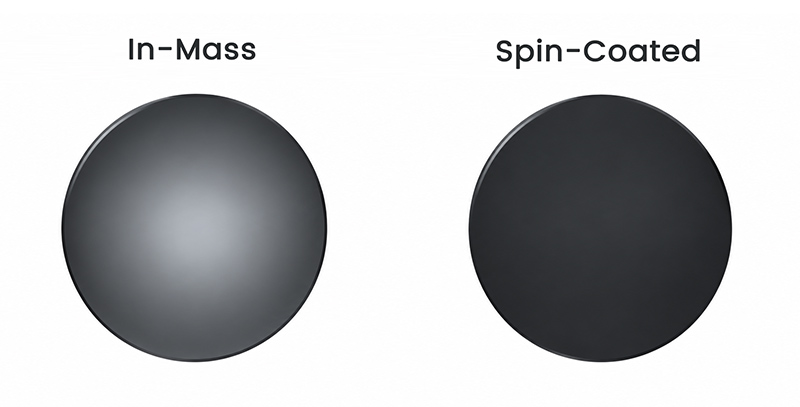
- In-Mass Photochromic Lenses (Uniformity Easily Compromised): In-mass photochromic lenses blend photochromic molecules uniformly throughout the lens substrate. Variations in lens thickness directly affect darkening performance. Typically, a lens is thinner at the center and thicker at the edges. Under identical UV exposure, thinner areas contain fewer photochromic molecules and turn lighter, while thicker areas contain more and turn darker. For wearers with high prescriptions (e.g., over -4.00 D), this thickness disparity creates a light center and dark border—the infamous "panda eye" effect. This not only looks unappealing but also causes inconsistent UV protection across different areas of the lens.
- Spin-Coated Photochromic Lenses (Superior Uniformity): Spin-coated photochromic lenses feature an independent photochromic layer applied evenly across the lens surface using high-speed spin coating. The thickness of this photochromic layer is uniform and entirely independent of the underlying substrate's thickness. Consequently, regardless of high or low prescription power, tinting remains smooth and uniform.
Conclusion: This standard effectively imposes a death sentence on "in-mass" lenses for high-prescription wearers.
3. Light Transmittance Grading
The national standard categorizes photochromic lenses into Categories 0 to 4 based on light transmittance, but only requires that "there is a difference between the faded state and the darkened state."
Theoretically, if light transmittance drops from 80% to 64%—a mere 16% reduction in brightness—it still qualifies as a compliant photochromic lens, even though its shading effect is virtually useless.
The bottom line: Compliant with national standards ≠ High performance. Unusually cheap photochromic lenses on the market are highly likely "barely passing" products manufactured right on the line of compliance.
II. Understanding the 4 Core Parameters
1. Darkening Depth: Darker Isn't Always Better—Both Ends Must Qualify
Darkening depth depends on the gap between faded transmittance vs. darkened transmittance:
- Premium Lenses: Faded state > 85% (nearly clear) | Darkened state 15%–20% | Ideal for frequent indoor/outdoor switching; close to sunglasses performance.
- Budget Lenses: Faded state slightly grey | Darkened state 50%–60% | Very poor sun-shading performance.
- Note: Darker color does not equal better performance—it depends on the scenario. Category 1 or 2 tinting is sufficient for daily commuting. Category 4 lenses are extremely dark, prohibited while driving, and meant exclusively for special environments like high-altitude skiing or deserts.
2. Transition Speed: "Fast Darkening, Slow Clearing" is the Law of Physics
- Fast Darkening: Reaches most of its depth within 20 to 30 seconds under direct sunlight—a threshold most products easily achieve.
- Slow Fading: Takes 2 to 5 minutes to noticeably lighten after coming indoors, and over 10 minutes to become completely transparent.
Complaints about lenses remaining dark long after stepping indoors reflect the inherent physical property of photochromic materials, not a quality defect. Currently, no photochromic lens can instantly turn crystal clear upon stepping indoors. If you cannot accept this delay, it's best to save your money.
3. Tinting Uniformity: The Technological Divide (In-Mass vs. Spin-Coated)
- In-Mass (Matrix): Photochromic agents mixed inside lens material. Durable, heat-resistant, long lifespan. Cons: Prone to "panda eye" effect and poor uniformity with high prescriptions.
- Spin-Coated (Surface): Photochromic layer spin-coated onto surface. Uniform color, fast speed, no color difference even on high prescriptions. Cons: Risk of coating wear; vulnerable to aging under prolonged intense sun exposure.
Buying Tip: If your prescription exceeds -4.00 D (400 degrees), go straight for spin-coated lenses. Don't hesitate—in-mass lenses will almost certainly fail on your face.
4. Lifespan: PhotochromicLenses Have an "Expiration Date"
In industry terms, "1 cycle" = Transparent → Darkest → Faded back to Transparent (similar to a full battery cycle on a smartphone).
- Older Models (10 years ago): Lasted ~2,000 cycles; degraded noticeably after 1 year of heavy use.
- Mainstream Current Products: Improved to 5,000 – 7,000 cycles, lasting 2 to 3 years under normal usage.
- Signs of lens aging: Inability to turn deep dark in sunlight, or failure to clear completely indoors (leaving a faint permanent tint overnight). When this happens, it doesn't mean you bought a fake—it simply means the lens has reached the end of its service life.
III. Who Should (and Shouldn't) Buy Photochromic Lenses?
1. These 4 Groups Can Buy Without Hesitation
People frequently moving between indoors and outdoors: Those who dislike carrying two pairs of glasses (e.g., field workers, parents walking kids).
Convenience seekers: Anyone who wants to minimize taking off and putting on glasses.
High-prescription wearers: People who find clip-on sunglasses too heavy and fit-over frames too bulky, wanting an all-in-one solution.
Light-sensitive or UV-allergic individuals: Photochromic lenses block sunlight while saving the cost of a separate pair of prescription sunglasses.
2. These 3 Groups Should Hold Onto Their Wallets
Indoor-bound individuals: Spending less than 1 hour a day in the sun makes paying extra hundreds for an unused feature poor value for money.
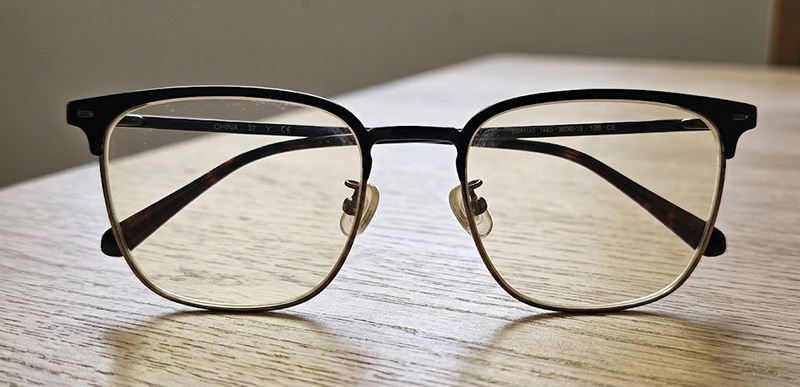
Perfectionists with zero tolerance for base tint: Faded photochromic lenses always retain a subtle greyish tint; avoid if you require 100% pristine clarity.
Frequent drivers (especially polarized lens wearers): Car windshields filter out UV rays, significantly dampening the darkening effect (unless buying specialized, pricier in-car photochromic lenses).
Summary
Photochromic lenses are not a marketing gimmick; they legitimately solve the "2-in-1" convenience problem. However, they are not as flawless as advertisements suggest: slow fading, limited lifespan, and higher prices are objective facts. Understand their characteristics and shortcomings before buying to ensure a satisfying experience.