







Single Vision Lenses Explained: Types, Benefits, and Applications
Single Vision Lenses Explained: Types, Benefits, and Applications
If you’ve ever been handed an eyeglass prescription, chances are high that you were prescribed single vision lenses. As the most common type of prescription lens on the market, single vision lenses are the standard fix for clear, comfortable vision across all age groups.
Whether you're buying your very first pair of prescription glasses or just trying to decode your optical prescription, here is everything you need to know about single vision lenses—how they work, their primary types, key benefits, and everyday applications.
What Are Single Vision Lenses?
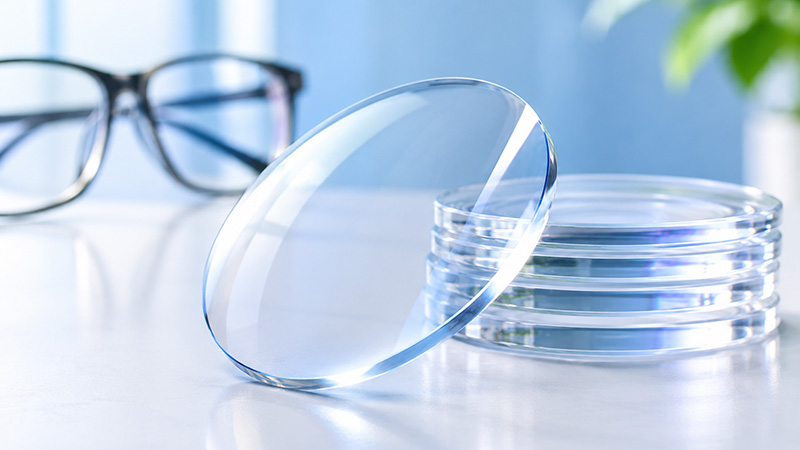
A single vision lens features a single, uniform optical power across its entire surface. Unlike bifocals or progressive lenses—which combine multiple focal powers into one lens to address both near and far distances—single vision lenses correct vision for one specific focal distance at a time.
They are primarily used to correct common refractive errors by refocusing light directly onto your retina:
- Myopia (Nearsightedness): Difficulty seeing objects far away clearly.
- Hyperopia (Farsightedness): Difficulty focusing on nearby objects.
- Astigmatism: Distorted or blurred vision at all distances caused by an irregularly shaped cornea.
Key Types of Single Vision Lenses
While all single vision lenses share a single focal point, they are customized according to your specific visual requirements:
1. Distance Lenses
Designed for people with myopia (nearsightedness), distance lenses help you see things far away.
- Best used for: Driving, watching television, attending sporting events, or general daily wear.
2. Reading Lenses
Designed for individuals with hyperopia (farsightedness) or early-stage presbyopia (age-related inability to focus on close objects).
- Best used for: Reading books, examining fine details, sewing, or hobbies requiring close-up precision.
3. Intermediate (Computer) Lenses
Tailored specifically for mid-range vision—typically between 20 to 40 inches (50 to 100 cm) from your eyes.
- Best used for: Working on desktop computers, reading music on a stand, or performing workbench tasks.

Material & Structural Options
Single vision lenses are not a one-size-fits-all solution; they come in various materials and design profiles:
|
Material / Profile |
Key Characteristics |
Best Suitable For |
|---|---|---|
|
Standard Plastic (CR-39) |
Cost-effective, good optical clarity |
Low to moderate prescriptions |
|
Polycarbonate |
Highly impact-resistant, lightweight |
Kids, sports eyewear, safety glasses |
|
High-Index Plastic |
Thinner and lighter profile for stronger prescriptions |
Strong prescriptions (+/- 4.00 diopters and above) |
|
Aspheric Design |
Flatter curves that reduce bulgy "bug-eye" magnification |
Stronger prescriptions needing a sleeker look |
Major Benefits of Single Vision Lenses
- Wide, Unobstructed Field of View: Because the optical power is uniform throughout the lens, you get edge-to-edge clarity without distortion or "swim effect" experienced with progressive lenses.
- Easy Adaptation: There is virtually zero learning curve. Your eyes adapt instantly when you put them on.
- Affordability: Compared to multifocals or progressives, single vision lenses are significantly less expensive to manufacture and purchase.
- Versatility: They fit easily into almost any frame style, from rimless to oversized acetate frames.
Recommended Lens Coatings & Upgrades
To get the most out of your single vision glasses, consider adding functional coatings:
- Anti-Reflective (AR) Coating: Eliminates glare from night driving and digital screens, improving clarity and reducing eye strain.
- Blue Light Blocking Filter: Helps filter high-energy visible (HEV) blue light from digital screens for all-day computer users.
- Scratch-Resistant Coating: Protects your lenses from everyday wear and tear.
- Photochromic Lenses (e.g., Transitions®): Lenses that automatically darken outdoors in sunlight and become clear indoors.
Summary: Are Single Vision Lenses Right for You?
Single vision lenses remain the ultimate solution for anyone needing dedicated correction for distance, reading, or computer work. If your prescription lists values under Spheroid (SPH) and Cylinder (CYL) without an ADD power, single vision lenses are precisely what your optometrist ordered.
Talk with your eye care professional to choose the right material and lens coatings tailored to your lifestyle and daily routine!